
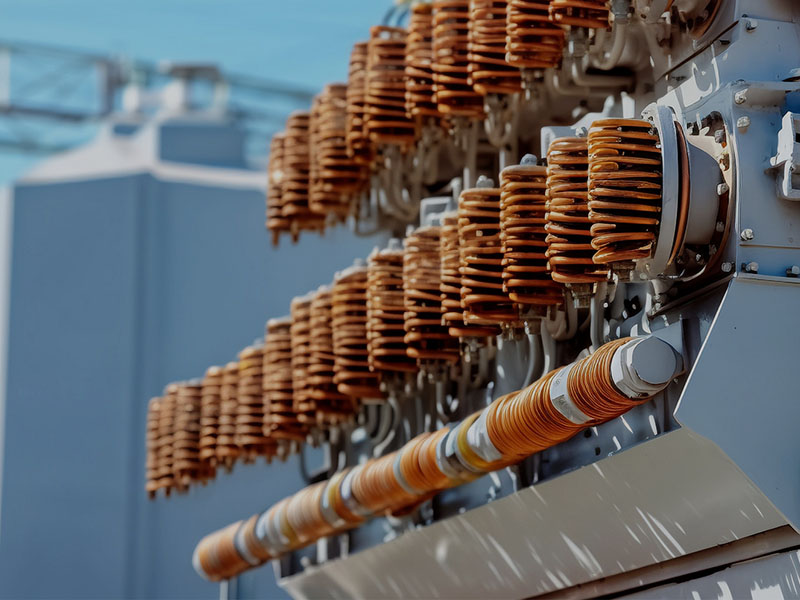
Comprehensive Technical Guide to Power and Distribution Transformers
1. Introduction
Transformers are among the most fundamental and mission-critical components in modern electrical and electronic systems. From industrial power supplies and renewable energy infrastructure to electric vehicles, medical equipment, and telecommunications, transformers enable safe, efficient, and reliable energy transfer across nearly every sector of technology-6. A poorly designed or poorly specified transformer can lead to efficiency losses, thermal problems, electromagnetic interference, compliance failures, or even complete system failure-6. This technical guide provides a comprehensive engineering reference for understanding, specifying, selecting, installing, maintaining, and future-proofing power and distribution transformers in professional systems.
2. Operating Principles and Fundamental Theory
2.1 Basic Principle of Electromagnetic Induction
At its core, a transformer is an electromagnetic device that transfers electrical energy from one circuit to another through a magnetic field, without direct electrical connection between the two circuits. A typical transformer consists of three main elements-6:
A magnetic core, which provides a controlled path for magnetic flux
A primary winding, which receives electrical energy from the source
A secondary winding, which delivers transformed electrical energy to the load
By changing the ratio of turns between the primary and secondary windings, a transformer can:
Increase voltage (step-up)
Decrease voltage (step-down)
Provide galvanic isolation between circuits
Match impedances
Measure or sense current and voltage safely
2.2 Key Electrical Parameters and Performance Metrics
When specifying or designing a transformer, the following electrical parameters define its behavior:
Rated Power (kVA/MVA) – The apparent power the transformer can deliver continuously at rated voltage and frequency without exceeding specified temperature rise limits. Proper sizing requires careful analysis of load profiles, including peak demand and duty cycles.
Voltage Ratio – The ratio of primary to secondary voltages at no-load, directly determined by the turns ratio. For three-phase transformers, the vector group (e.g., Dyn11, Yyn0) defines the phase displacement between primary and secondary windings and must match system requirements.
Impedance Voltage (Uk%) – Expressed as a percentage of rated voltage, this parameter determines short-circuit current levels and voltage regulation. Lower impedance improves voltage regulation but increases fault current stress.
Efficiency – Ratio of output power to input power. Modern distribution transformers routinely achieve efficiencies of 97–99.5% at rated load. Losses are categorized as no-load (core) losses and load (copper) losses.
Temperature Rise – Defined as the temperature difference between windings and ambient at rated load, typically 65°C or 75°C for most designs. Exceeding rated temperature rise accelerates insulation aging and shortens service life.
2.3 Core Materials and Magnetic Design
Core material selection profoundly impacts transformer performance, size, and efficiency:
| Material | Relative Permeability | Saturation Flux Density (T) | Core Loss | Applications |
|---|---|---|---|---|
| Grain-Oriented Silicon Steel (GOES) | ~30,000–40,000 | 1.7–1.9 | Medium | Standard distribution and power transformers |
| High-Permeability GOES | ~45,000–55,000 | 1.7–1.9 | Low | High-efficiency designs |
| Amorphous Steel | ~200,000–300,000 | 1.5–1.6 | Very low | DOE-compliant, ultra-high efficiency units |
| Nanocrystalline Alloys | ~80,000–100,000 | 1.2–1.4 | Extremely low | Specialized and high-frequency applications |
Grain-oriented silicon steel remains the industry standard for most applications. However, amorphous steel cores are gaining prominence as energy efficiency regulations tighten. The U.S. Department of Energy has proposed new efficiency standards that would require almost all new distribution transformers to feature amorphous steel cores, which are significantly more energy efficient than conventional grain-oriented electrical steel-11. If adopted within the DOE‘s proposed timeframe, the new rule would come into effect in 2027-.
Magnetic Design Considerations:
Flux density selection directly impacts core size, weight, and no-load losses
Stacking factor accounts for insulation between core laminations
Joint design affects local flux distribution and audible noise
Core geometry influences leakage flux and stray losses
3. International Standards and Regulatory Compliance
Transformer design, testing, and operation are governed by comprehensive international standards. Compliance is essential for safety, performance, and market access.
3.1 Key International Standards
| Standard | Scope |
|---|---|
| IEC 60076 series | Power transformers — complete series covering ratings, testing, temperature rise, short-circuit withstand, etc. |
| IEEE C57 series | Comprehensive North American standards for transformers, regulators, and reactors |
| IEEE C57.94-2025 | Recommended practice for installation, application, operation, and maintenance of dry-type distribution and power transformers. This 2025 revision supersedes the 2015 edition and was published on February 2, 2026-1 |
| IEEE C57.170-2025 | Guide for condition assessment of liquid-immersed transformers, reactors, and their components- |
| DOE 10 CFR Part 431 | U.S. Department of Energy efficiency standards for distribution transformers |
| CSA C802.2 | Canadian standards for dry-type transformers |
| GB/T 1094 | Chinese national standard equivalent to IEC 60076 |
3.2 U.S. DOE Efficiency Standards — What to Expect in 2027
The U.S. Department of Energy has proposed new energy-efficiency standards for three categories of distribution transformers: liquid-immersed, low-voltage dry-type, and medium-voltage dry-type-. The proposed rule would come into effect in 2027 if approved, amending the current energy conservation standards-.
Key implications for buyers and specifiers:
Almost all new distribution transformers would require amorphous steel cores-
Implementation is projected to reduce CO₂ emissions by 340 million metric tons over 30 years — equivalent to the annual emissions of 90 coal-fired power plants-
Potential consumer savings of approximately $15 billion over 30 years-
Transformer designs will change, affecting size, materials, and performance trade-offs-15
Practical guidance: For projects planned beyond 2027, specify DOE-compliant transformers now to avoid regulatory delays. For existing facilities, conduct a TCO analysis comparing continued operation of existing units against replacement with higher-efficiency models.
3.3 Testing Requirements and Acceptance Criteria
Factory acceptance testing (FAT) and site commissioning testing verify compliance with specified standards:
Routine Tests (performed on every unit):
Measurement of winding resistance
Measurement of voltage ratio and check of vector group
Measurement of short-circuit impedance and load loss
Measurement of no-load loss and excitation current
Dielectric tests (applied voltage and induced voltage)
Insulation resistance measurement (minimum 100 megohms for bushings with 500V megger)-26
Type Tests (performed on a representative unit):
Temperature rise test
Lightning impulse test (LI)
Switching impulse test (SI)
Short-circuit withstand test
Special Tests (as agreed between manufacturer and purchaser):
Determination of capacitances and dissipation factor
Measurement of zero-sequence impedance
Measurement of sound level
Measurement of harmonics of no-load current
Partial discharge measurement
4. Transformer Selection Guide
Selecting the optimal transformer type for a given application requires systematic evaluation of multiple factors. This section provides a structured decision framework.
4.1 Dry-Type vs. Oil-Immersed Transformers
The fundamental distinction lies in the cooling and insulation medium-41:
Dry-Type Transformers:
Cooling/Dielectric: Air cooling; solid insulation (VPI varnish or cast-resin epoxy); no liquid-41
Fire Behavior: No flammable liquid; low fire load; smoke possible under fault-41
Location Fit: Indoor, basements, hospitals, shopping malls, tunnels, subway stations-41
Maintenance: Low — no oil sampling; periodic cleaning-41
Thermal/Overload Margin: Moderate; sensitive to dust and ventilation-41
Environmental Risk: No liquid spill risk-41
Capex: Higher per kVA at larger sizes-41
Oil-Immersed Transformers:
Cooling/Dielectric: Oil/ester cooling; fluid dielectric; sealed tank-41
Fire Behavior: Mineral oil: lower fire point; ester: higher fire point, self-extinguishing-41
Location Fit: Outdoor yards, pad-mounts, utility stations-41
Maintenance: Oil testing, gasket checks, radiator cleaning-41
Thermal/Overload Margin: High — excellent heat dissipation and thermal inertia-41
Environmental Risk: Mineral oil spill risk; ester fluids mitigate impact-41
Capex: Lower per kVA for medium/high voltage ratings-41
Decision Matrix:
| Criterion | Dry-Type | Oil-Immersed |
|---|---|---|
| Indoor installation | ✓ Preferred | — Requires containment/fire protection |
| Outdoor substation | — Not recommended | ✓ Standard choice |
| High fire risk environment | ✓ Mandatory | Only with ester fluid |
| High overload capacity | Moderate | Excellent |
| Above 35 kV | — Not practical | ✓ Only practical option |
| Tight maintenance budget | ✓ Lower ongoing cost | — Higher ongoing cost |
4.2 Cooling System Selection (Oil-Immersed Transformers)
For oil-immersed transformers, cooling method determines capacity, efficiency, and reliability. Four primary cooling systems are in common use-51:
ONAN (Oil Natural Air Natural): Relies on natural convection of oil and air. The simplest and most reliable design with no moving parts, requiring minimal maintenance-52. Suitable for distribution transformers up to medium capacity in moderate climates.
ONAF (Oil Natural Air Forced): Adds fans to force air across cooling fins, enhancing heat dissipation. Allows the transformer to handle higher loads without excessive temperature rise-52. Fans can be activated based on load or temperature. Provides approximately 130–150% of ONAN rating.
OFAF (Oil Forced Air Forced): Uses pumps to circulate oil and fans to cool it through radiators. Common in large power transformers where natural convection alone is insufficient-52. Provides 180–220% of ONAN rating. Suitable for high-capacity transformers in hot environments.
ODAF (Oil Directed Air Forced): Directs oil flow specifically through windings with forced air cooling. Provides the highest cooling capacity — 250–300% of ONAN rating — for very large power transformers (>100 MVA).
Selection criteria:
ONAN → Distribution transformers, moderate loads, temperate climates
ONAF → Industrial plants, peak load management, hot climates
OFAF/ODAF → Large power transformers, high continuous loads, critical infrastructure
4.3 Sizing and Loading Guidelines
Step 1: Load Profile Analysis
Document existing and projected load data, including:
Peak demand (kVA or MVA)
Load factor (average load ÷ peak load)
Duty cycle and load duration curves
Harmonic content (THD)
Future expansion requirements (typically add 20–30% margin)
Step 2: Ambient Conditions
Operating conditions directly affect transformer capacity:
Temperature: For every 10°C above 40°C ambient, derate by approximately 5%
Altitude: For installations above 1,000 m, derate due to reduced cooling efficiency
Humidity: High humidity accelerates insulation degradation; ensure proper enclosure rating
Step 3: Overload Capability
IEC 60076-7 provides loading guides for oil-immersed transformers. Typical short-term overload capabilities:
| Load Condition | ONAN | ONAF | OFAF |
|---|---|---|---|
| Normal cyclic loading (2 hours) | 120–130% | 115–125% | 110–120% |
| Emergency loading (30 minutes) | 150% | 140% | 130% |
⚠️ Caution: Frequent or prolonged overloading accelerates insulation aging. IEEE C57.91 provides detailed loading guidelines for different transformer types.
5. Installation and Commissioning
Proper installation and commissioning are critical to transformer reliability and longevity. The following procedures are based on industry best practices and IEEE C57.94-2025-1.
5.1 Pre-Installation Requirements
Site Assessment Checklist:
Ventilation: Ensure adequate airflow around the transformer. For indoor installations, maintain a clear space of approximately 1.25 meters on all sides-26. Check for potential obstructions to air circulation-24.
Foundation: The foundation must be sturdy, level, and dry. Verify the floor‘s load-bearing capacity can support the transformer’s full weight. For installations with rollers, appropriate rails should be provided-26.
Environmental Conditions: Measure ambient temperature ranges (-5°C to 40°C acceptable), check humidity levels (<95% recommended), and consider altitude effects on cooling efficiency-24.
Accessibility: Ensure adequate space for installation, maintenance, and future replacement. Plan for cable entry and routing-24.
Regulatory Compliance: Verify local electrical codes, fire safety requirements, and environmental regulations are met-24.
Documentation Required:
Manufacturer datasheets and technical manuals
Design drawings, wiring diagrams, and as-built plans
Relevant electrical standards (IEC 60076, IEEE C57, local codes)
Test certificates and factory acceptance test reports
5.2 Installation Procedures
Mechanical Installation:
Inspect the transformer for any damage incurred during transport
Position the transformer on the prepared foundation with proper alignment
Verify anchoring meets seismic requirements if applicable
Check physical condition, oil levels (for oil-filled units), and tap changer position-22
Electrical Installation:
Verify cable connections, phasing, polarity, and insulation resistance
Check grounding, earthing, and surge protection systems
Inspect bushings, control wiring, and protective devices for proper installation
Clean bushings and check for fine cracks or other damage before installation-26
For oil-filled units, install the conservator and connecting pipe with Buchholz relay. Ensure the Buchholz relay is oriented correctly, with the arrow on it pointing toward the conservator-26
Oil Handling (Oil-Immersed Units):
Necessary arrangements for oil draining (oil soak pits) should be made in case of fire. Fire separation walls should be installed when deemed necessary-26.
For conservator installations, install the flexi separator (air cell) inside the conservator. Ensure hooks on the air cell are properly engaged with brackets inside the conservator. Check for leaks — the conservator with the air cell has been pressure-tested at the factory and dispatched under slight positive pressure-26.
5.3 Commissioning Tests
Pre-energization tests verify the transformer is ready for service:
Mechanical and Structural Verification:
Verify proper installation alignment and support
Check oil levels (oil-immersed units)
Confirm accessibility for operation and maintenance-22
Electrical Testing:
Insulation resistance, continuity, and polarity tests
Winding resistance and turns ratio tests
Excitation current and vector group verification-22
Protection Device Verification:
Test Buchholz relay, pressure relief devices, and temperature sensors
Verify alarm and trip functionality
Confirm coordination with upstream and downstream protection systems-22
Tap Changer and Cooling System Checks:
Operate tap changer under no-load conditions and verify settings
Test cooling fans, pumps, and temperature control systems-22
Energization and Operational Testing:
Energize the transformer under controlled conditions
Monitor voltages, currents, and load response
Observe performance under varying operational conditions to confirm stability-22
Commissioning Documentation:
All test results, measurements, and observations should be documented in a formal commissioning report. Record any defects, deviations, or incomplete tasks with assigned responsibilities and priority levels for resolution-22.
6. Operation and Maintenance
Regular maintenance is the single most effective strategy for extending transformer service life and preventing unexpected failures. Proper maintenance can prevent up to 75% of transformer failures-33 and extend equipment lifespan by 30% or more compared to sporadic upkeep-33.
6.1 Maintenance Frequency and Procedures
| Frequency | Tasks |
|---|---|
| Daily to Weekly | Visual checks for leaks, overheating, and unusual noises. Verify oil levels and cooling fan operation- |
| Monthly | Visual inspections — check physical condition, oil levels (oil-immersed), cooling system operation, and overall cleanliness-33 |
| Semi-Annual | Oil analysis — dielectric strength, moisture content, and dissolved gas analysis (DGA) for critical units |
| Annual | Electrical tests — insulation resistance (IR), turns ratio (TTR), winding resistance, and bushing cleaning-33 |
| Every 3–6 months | Critical transformers serving essential loads require DGA testing every 3–6 months- |
| Every 15–20 years | Major overhaul — reconditioning typically retains the magnetic core while improving performance through winding redesign and material upgrades |
6.2 Oil Testing and Analysis (Oil-Immersed Transformers)
Dielectric Tests:
Dielectric breakdown voltage (BDV): Measures oil‘s ability to withstand electrical stress. Low BDV indicates contamination or moisture.
Moisture content: Excess moisture accelerates insulation paper degradation. Maintain below 20 ppm for critical units.
Dissolved Gas Analysis (DGA) — The Gold Standard:
DGA is widely regarded as the gold standard for monitoring transformer health-. Real-time monitoring of key fault gases enables early fault detection:
| Gas | Typical Source | Interpretation |
|---|---|---|
| H₂ (Hydrogen) | Partial discharge, arcing | Low-level PD: normal; rising: incipient fault |
| CH₄ (Methane) | Thermal decomposition of oil | Moderate temperature overheating |
| C₂H₄ (Ethylene) | High-temperature thermal decomposition | Hot spots > 300°C |
| C₂H₂ (Acetylene) | High-energy arcing | Immediate investigation required |
| CO, CO₂ | Cellulose insulation decomposition | Paper degradation — trending analysis critical |
A DGA online monitoring system provides continuous, automated surveillance of transformer health by analyzing dissolved gases in real time, enabling proactive maintenance rather than reactive repairs-. Advanced systems with AI integration deliver fault detection accuracy above 95% and provide actionable alerts weeks before conventional methods would detect a problem-.
6.3 Cooling System Maintenance
ONAN Systems: Minimal maintenance — keep radiators clean and unobstructed.
ONAF Systems: Inspect fans annually for bearing wear, vibration, and proper operation. Fan replacements typically required every 5–7 years-54.
OFAF/ODAF Systems: Regular inspection of pumps, valves, and control systems. Implement advanced monitoring for these complex systems-54.
Common cooling system issues:
Dust and debris accumulation on cooling fins — schedule regular cleaning
Fan motor failure — maintain spare fan motors for critical installations
Oil pump seal leakage — monitor for oil stains around pump housing
Radiator blockage — check for external obstructions and internal oil flow
6.4 Predictive Maintenance and Smart Monitoring
Recent advances in IoT, cloud computing, and AI are transforming transformer maintenance from reactive to predictive-65:
IoT-Enabled Monitoring: Continuous capture of oil temperature, winding temperature, load current, voltage, and dissolved gases. Data is sent to the cloud through gateways, and machine learning algorithms analyze it to predict faults before they occur-60.
Digital Twins: Virtual replicas of physical transformers enable simulation and optimization of performance under various load conditions. Modern digital twin systems achieve lifespan prediction accuracy of up to 92%-47.
Benefits of Smart Monitoring:
Predictive maintenance enabled by smart monitoring can reduce unexpected outages by 41% while cutting outage duration by 60%-65
Condition-based maintenance reduced annual maintenance events by 66%, extended transformer lifespan by 40%, cut maintenance costs by 35%, and improved reliability by 28%-65
Intelligent sensors detect hidden energy inefficiencies — voltage micro-fluctuations, harmonic distortions, phase imbalances — that can account for up to 15% of total energy waste in industrial facilities-65
7. Advanced Technologies and Emerging Trends
7.1 Natural Ester Fluids (FR3 and Alternatives)
Biodegradable ester fluids derived from vegetable oils are rapidly gaining traction as an eco-friendly alternative to mineral oil-52:
| Property | Mineral Oil | Natural Ester (FR3) |
|---|---|---|
| Flash point | ~160°C | >300°C (over 100°C higher) |
| Fire point | ~170°C | >350°C |
| Biodegradability | Low (~20–30%) | High (>95–99%) |
| Moisture absorption capacity | Low | High — maintains insulating properties when moist |
| Fire risk | Moderate — combustible | Low — self-extinguishing tendency |
| Source | Non-renewable petroleum | Renewable plant-based materials |
Natural ester fluids offer extended lifespan and safety benefits that often justify the higher upfront cost. They are particularly well-suited for environmentally sensitive installations and applications requiring enhanced fire safety-52.
7.2 Smart Transformers and Digitalization
The global smart transformers market is expanding rapidly, driven by tangible ROI. Modern intelligent transformers embed multiple sensors and connect to cloud platforms:
Key Technologies:
Temperature sensors tracking winding hot spots
Dissolved gas sensors monitoring fault indicators in real time
Vibration sensors detecting mechanical anomalies
Partial discharge monitoring with sensitivity ≤5 pC-47
Edge processors performing initial data filtering before cloud transmission-65
What Smart Transformers Enable:
Condition-based maintenance — intervene precisely when needed, not on fixed schedules
Fault prediction weeks or months before conventional methods would detect an issue
Grid optimization through real-time load and voltage management
Hidden energy waste detection that conventional monitoring misses
While the overall transformer market grows modestly, the smart transformer segment expands at significantly higher rates. For millions of transformers already in service, retrofitting with add-on sensors and intelligent devices offers a cost-effective path to smart capabilities without full replacement-65.
7.3 Emerging Technologies on the Horizon
Nanotechnology-Enhanced Fluids: Fluids enhanced with nanoparticles improve thermal conductivity and dielectric strength, reducing hotspot temperatures and potentially extending transformer life by decades. This remains an active research area with promising early results.
Computational Fluid Dynamics (CFD) in Design: CFD-driven radiator design is optimizing cooling efficiency while reducing costs for large power transformers-51.
AI-Integrated DGA: Machine learning models are being trained to interpret DGA data with higher accuracy than traditional interpretation methods (e.g., Rogers ratios, Duval triangles). AI-integrated DGA with continuous online monitoring delivers fault detection accuracy above 95%-.
Fully Sealed Maintenance-Free Designs: Recent innovations in sealed transformer designs have extended maintenance-free cycles to 15 years for certain applications-47.
8. Troubleshooting Common Transformer Issues
| Symptom | Possible Causes | Recommended Actions |
|---|---|---|
| Overheating (excessive temperature rise) | Overload, inadequate cooling, high ambient temperature, obstructed radiators | Reduce load, inspect/clean cooling system, check ambient conditions |
| Buchholz relay activation | Gas accumulation (internal arcing), low oil level, mechanical vibration | Perform DGA analysis, inspect for leaks, check relay orientation |
| Unusual noise (increased hum or vibration) | Loose core laminations, over-excitation, mechanical resonance | Check voltage levels, inspect core clamping, verify mounting |
| High DGA gas concentrations (especially C₂H₂) | Internal arcing, partial discharge, severe overheating | De-energize immediately, perform thorough internal inspection |
| Low insulation resistance | Moisture ingress, contamination, insulation aging | Dry out transformer, clean bushings, replace oil if necessary |
| Oil leaks | Gasket failure, tank cracks, bushing seal degradation | Identify leak source, replace gaskets, repair tank |
| Tap changer malfunction | Worn contacts, mechanical binding, control circuit issues | Inspect contacts, lubricate mechanism, verify control wiring |
| Excessive no-load loss | Core damage, shorted laminations, improper core grounding | Perform core insulation testing, inspect for core ground faults |
9. Glossary of Key Terms
| Term | Definition |
|---|---|
| Buchholz relay | Gas-actuated relay installed in oil-filled transformers to detect internal faults |
| Conservator | Oil expansion tank mounted above main tank to accommodate oil volume changes with temperature |
| DGA (Dissolved Gas Analysis) | Analysis of gases dissolved in transformer oil to detect incipient faults |
| Insulation resistance (IR) | Measure of winding-to-ground and winding-to-winding insulation quality |
| Load loss | Losses that vary with load current (primarily I²R losses in windings) |
| No-load loss | Core losses present whenever transformer is energized, regardless of load |
| OLTC (On-Load Tap Changer) | Tap changer that operates while transformer is under load |
| Partial discharge (PD) | Localized electrical discharge that partially bridges insulation between conductors |
| TTR (Turns Ratio Test) | Measurement confirming ratio of primary to secondary turns |
| Vector group | Designation of winding connections and phase displacement (e.g., Dyn11, Yyn0) |
| VPI (Vacuum Pressure Impregnation) | Dry-type transformer manufacturing process using vacuum to impregnate windings with varnish |
10. References and Further Reading
IEEE C57.94-2025: IEEE Approved Draft Recommended Practice for Installation, Application, Operation, and Maintenance of Dry-Type Distribution and Power Transformers
IEEE C57.170-2025: IEEE Guide for the Condition Assessment of Liquid Immersed Transformers, Reactors, and Their Components
IEC 60076 Series: Power Transformers (Parts 1–11)
Velatron (2026). Transformer Design & Engineering — Complete Practical Guide-6
MDPI Energies (2025). Power Transformers Cooling Design: A Comprehensive Review, 18(5), 1051-51
CHBEB (2025). Dry-Type vs Oil-Immersed Transformers: A Complete Comparison & Selection Guide-41
E3S Web of Conferences (2026). Cloud IoT Framework for Transformer Health Monitoring System and Predictive Failure Detection, 692, 03009-60
Sunbelt Solomon (2026). Advancements in Transformer Cooling Techniques-52
U.S. Department of Energy (2022). DOE Proposes New Efficiency Standards For Distribution Transformers-
About Zhongbian
This technical guide is maintained by Zhongbian Engineering as a professional resource for electrical engineers, project managers, and technical decision-makers. For questions about transformer specification, selection, or custom design, please contact our engineering team.